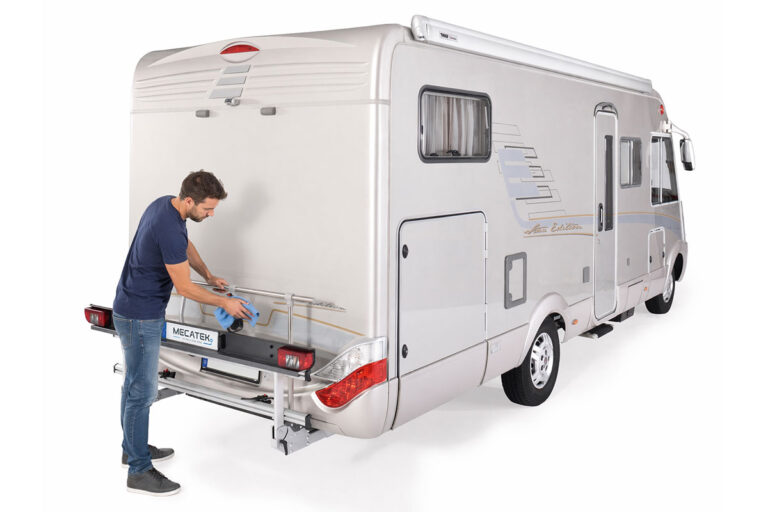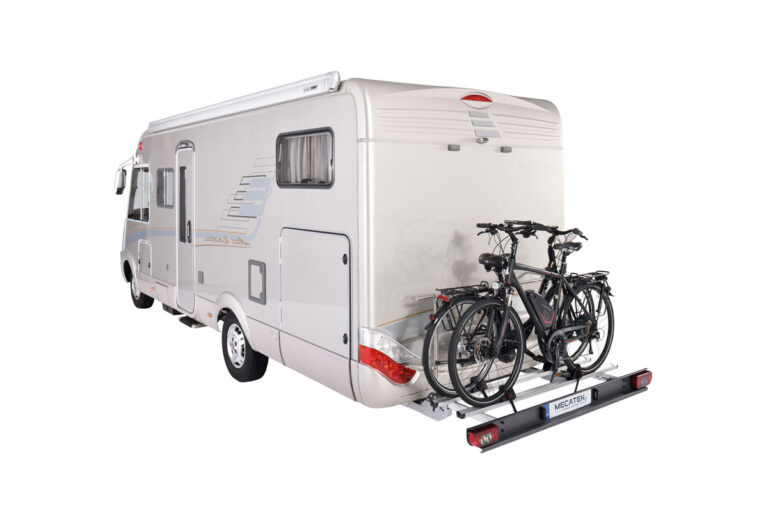

Many motorhome owners take their bikes on trips to maintain maximum mobility once they've reached their destination. Transporting a bike in the storage compartment or on a trailer is possible, but these transport methods are not the most suitable due to the loss of interior space and practical handling constraints on the road.
The best solution is to install a suitable bike rack. However, is it better to opt for a tow bar model You fixed to the rear wall that of a motorhome? We'll analyse these two options for you to help you decide.
How does a towbar bike rack work?
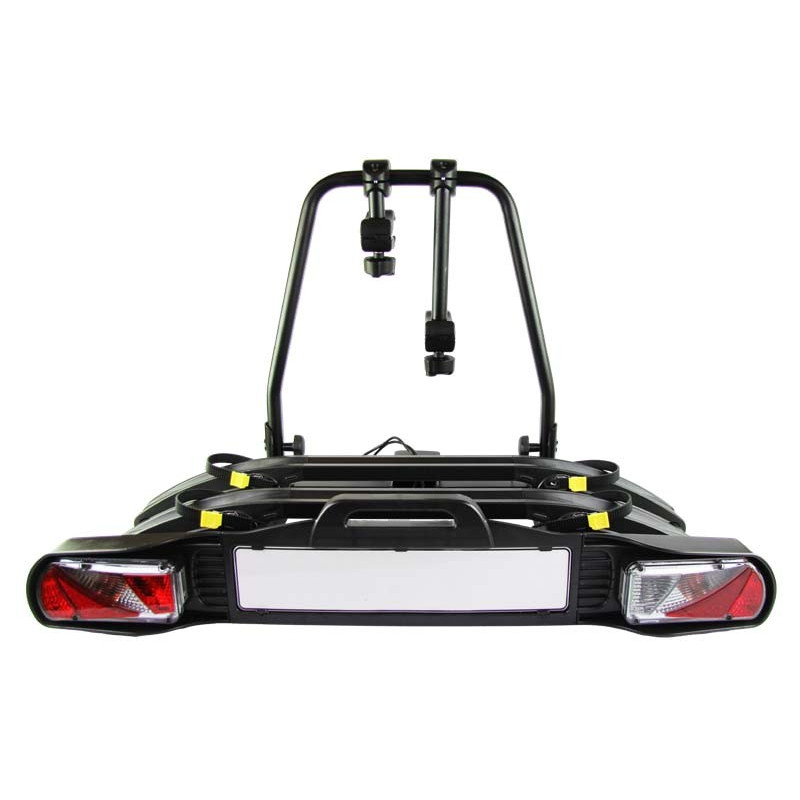
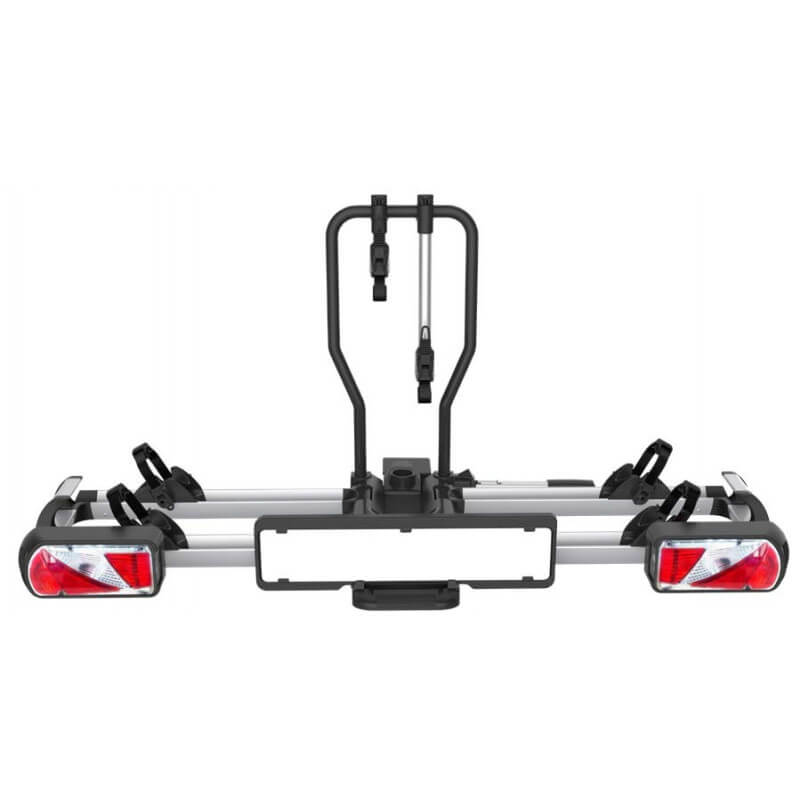
A towbar-mounted bike rack is fitted directly onto the metal tow ball – also called a hitch ball or tow hitch – that is attached to the rear of the motorhome. This is how the models work ST-Line and P-Line of Mecatek, which are specially calibrated to accommodate 2 standard or electric bicycles.
This system demonstrates great flexibility in use. It relies entirely on the vehicle's towing structure, which allows bikes to be loaded and unloaded at a relatively low, waist-height level, thereby limiting physical strain.
If your motorhome already has an approved tow hitch, the equipment can be fitted in a few moments without requiring any drilling or modifications to the bodywork.
How does a rear door bike rack work?
The rear-wall bike rack is a device fitted directly to the rear of the motorhome’s living area. It uses straps, rigid brackets and through-bolts to secure it to the bodywork.
On this type of model, the bikes are carried high up, which completely frees up the space under the bumper. This The system is lightweight and economical, However, it presents operational constraints for a motorhome. It directly stresses the vehicle's body panels, which are not always designed to withstand repeated dynamic forces, particularly on poor roads.
Which model to choose according to your vehicle and your uses?
Your choice should depend on the type of bikes you have and the layout of your motorhome.
If you own electric bikes (e-bikes), a tow-bar model (or a frame-mounted platform like the E-Bike or the Compact-Line) is the only reliable option. The high weight of e-bikes rules out the use of a wall-mounted bike rack, as it could deform the structure of your motorhome.
Another point to bear in mind: the total weight of the load carrier and its load is deducted from the hold’s load capacity. It is indeed essential not to excessively load the rear overhang of the vehicle, to avoid placing too much stress on the chassis or its extensions. For example, if your bike rack supports 2 e-bikes with a total weight of 90 kg, these 90 kg must be deducted from the payload available in the storage compartment. Furthermore, depending on your vehicle's characteristics, the installation of auxiliary suspensions (MCK Plug & Drive type) may also be necessary.
For any questions or feasibility studies concerning your motorhome's load-bearing capabilities, the Mecatek team remains at your disposal: contact us
If you’re travelling with your family and need to carry up to five bikes, opt for a sturdy chassis-mounted bike rack such as the Compact-Line.
The criteria to compare before buying
Before deciding on one of the Bike rack for motorhome from our catalogue, carefully compare the following technical criteria:
- The payload Our models show a load capacity of 60 to 130 kg.
- Gross Vehicle Weight Rating and Overhang Ensure that the combined weight of the equipment and bicycles does not exceed your vehicle's load capacity. Also, make sure the rear extension is not at risk of scraping when going over speed bumps.
- Congestion : Some of our models on a chassis or with a hitch can be folded away when empty.
Need to know more? Clear up all your doubts by requesting a free quote with Mecatek experts.