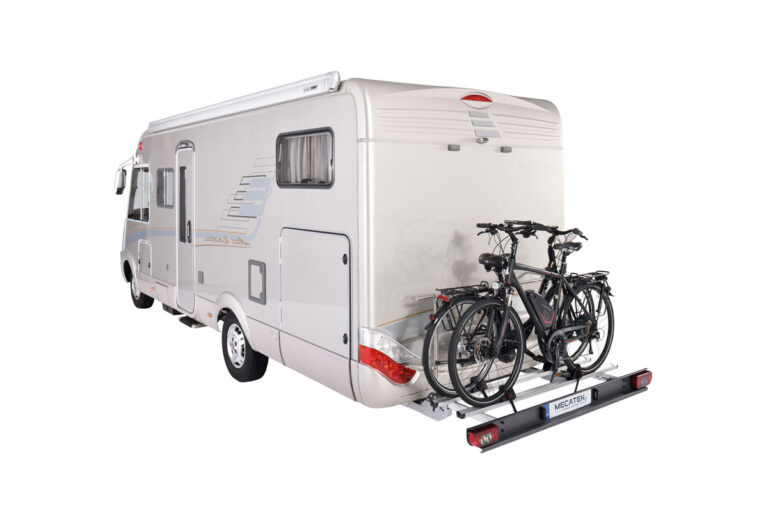
Installing a bicycle carrier is the most suitable solution for transporting one or more bicycles depending on the model installed. However, good equipment needs to be maintained. Given that a bicycle carrier is attached to the back of the motorhome, it is subjected to significant stresses (road vibrations and weather conditions). Regular maintenance is therefore essential for peace of mind on the road.
At the home of Mecatek (formerly Sawiko France), we offer you our advice as independent manufacturer of equipment for recreational vehicles, to help you look after your motorhome bike rack.
The items to check before and after each trip
Before every big departure, a eye test of the entire structure is essential. If you own a model installed on the towball such as the versions ST-Line You P-Line, ensure that the coupling head is securely clamped and free from play. For systems mounted directly onto the chassis, have the tightening torque of all carrying parts – chassis support and side members – supporting the load carrier checked once a year.
It will also be necessary to pay particular attention to the weight of the load carrier and its load, which must be deducted from the available load capacity in the hold. This precaution helps to prevent overloading the rear overhang and placing excessive strain on the chassis or its extensions. For example, if a bike rack loaded with two e-bikes has a total weight of 90 kg (rack + load), these 90 kg must be deducted from the boot’s payload capacity. Depending on your vehicle’s specifications, the installation of auxiliary suspension systems, such as the MCK Plug & Drive system, may also prove necessary.
Have a question or need a feasibility study? The Mecatek team is here to support you. Please contact us for further information.
On the return journey, checking the other way round is just as important. Repeated jolts can cause slight adjustments. So please check the removable parts and make sure that the return mechanism works perfectly on fold-away models such as the E-Bike or the Compact-Line.
Remember to clean the equipment and protect it against corrosion
Fitted at the rear end of the motorhome, the bike rack is directly exposed to aerodynamic turbulence. This area of low pressure draws in dust, mud and, above all, road salt in winter – substances that are particularly corrosive to metal structures.
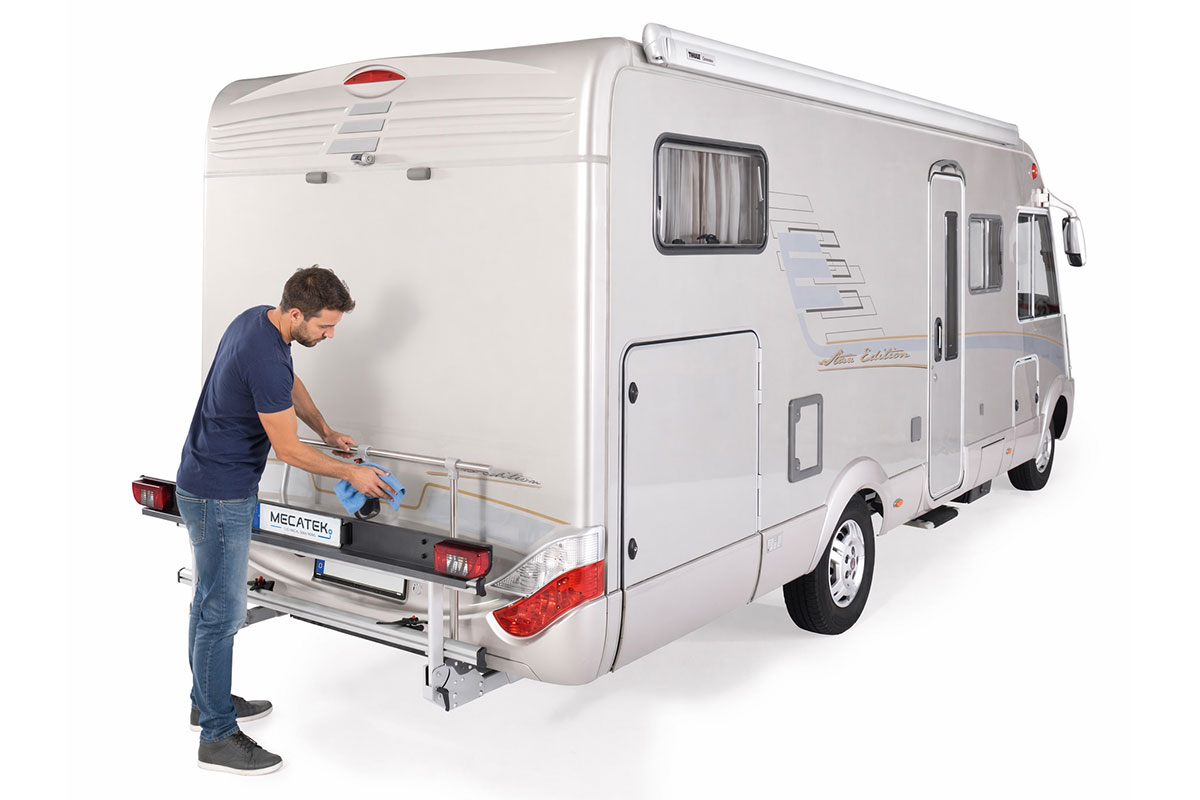
Get into the habit of Clean your bike rack with clean water and mild soap after every journey. Avoid using high-pressure washers for prolonged periods too close to the joints, as this may wash away the factory-applied grease.
Even though our Bike rack for motorhome incorporate premium-grade, approved and resistant coatings, the periodic application of a lubricating spray on the metal axles helps to enhance corrosion protection.
Check the fixings, rails and locking mechanisms
The safety of your bikes depends entirely on the reliability of the components that secure them to the bike rack. Check the following regularly: aluminium rails and shims which allow the wheels to be locked. The straps and quick-release buckles must show no signs of wear or UV-induced cracking. If this is the case, replace them immediately.
Lubricate the threads of the articulated mounting arms that hold the frames. If your clamps incorporate key-lockable tightening knobs, a squirt of lock spray will prevent the barrels from seizing.
Before each journey, make sure that the connection to the cable bundle is spot on: clean the pins on the male plug to ensure perfect visibility of the light bar and the licence plate holder. If a fault is found, please consult a specialist.
How to prolong the lifespan of your bicycle carrier?
To maximise the longevity of your bike rack, you can adopt a few simple daily best practices:
- Respect technical limits our bike rack models feature a robust payload capacity of 60 to 130 kg (holding up to 5 bikes on the Compact-Line). Never overload the carrier and ensure that you do not exceed the vehicle's maximum authorised mass.
- Reduce the leverage Always position the heaviest bikes (such as electric bikes) on the rails closest to the bodywork to ease the strain on the structure.
- Optimise the space When travelling empty, systematically fold away the foldable models (E-Bike or Compact-Line). This limits the length of the rear overhang and reduces the risk of scraping on the road surface when going over speed bumps.
Preventative servicing guarantees the long-term reliability of your journeys. If you notice any abnormal play in the structure or if the fitting of specific chassis extensions is necessary to consolidate your installation, entrust your vehicle to our workshops. For any intervention or technical advice, Request your free quote with Mecatek experts.